Scrolling Instagram, watching YouTube, editing Google Docs. That’s Web 2.0.
Web 2.0 describes the shift from static web pages to interactive, user-driven platforms that happened around the mid-2000s. As of 2024, 5.5 billion people use the internet globally, representing 68 percent of the world’s population, according to the International Telecommunication Union.
The term was coined by writer Darcy DiNucci in 1999 and popularized by Tim O’Reilly at the 2004 Web 2.0 Conference.
This article covers what is web 2.0, how it evolved, the features that define it, real-world examples, comparisons with Web 1.0 and Web 3.0, and how it affects business and SEO.
TL;DR: What Is Web 2.0?
Web 2.0 is the second generation of the internet where users don’t just read pages but actively create, share, and collaborate through social networks, blogs, wikis, and interactive applications. It’s defined by user-generated content, two-way communication, and social connections rather than the one-way publishing model of early websites. The web 2.0 definition centers on platforms that treat users as contributors, not just consumers.
Brief History of Web 2.0
Web 1.0 (late 1980s – early 2000s)
Static HTML pages functioned like digital brochures. You could read information but interaction was limited to forms and guestbooks. Content came from webmasters and companies.
The Term Emerges (1999)
Darcy DiNucci coined “Web 2.0” in January 1999 in Print magazine, describing a more interactive future web.
Mainstream Adoption (2004)
Tim O’Reilly and Dale Dougherty hosted the first Web 2.0 Conference in San Francisco, defining it around principles like treating the web as a platform and harnessing collective intelligence.
The Boom (2004-2006)
- Facebook launched in 2004
- YouTube went live in 2005
- WordPress and blogging platforms made publishing accessible
- TIME named “You” as Person of the Year in 2006, recognizing users creating content at scale
Web 2.0 isn’t a formal technical standard. It’s a label for the evolution from one-way publishing to interactive, collaborative spaces.
How Web 2.0 Works (Technologies & Mechanics)
When you like a post or see new messages without refreshing, several technologies work together behind the scenes.
Client-Side Technologies
- AJAX: Updates parts of a page without reloading everything
- JavaScript: Powers interactive elements, validation, and dynamic changes
- DOM manipulation: Updates what you see based on your actions
Server-Side & Data
- Languages: PHP, Python, Ruby, Node.js generate dynamic content
- Databases: MySQL, PostgreSQL store user profiles, posts, comments, media
- Cloud databases: Scale to billions of users
Data Exchange
- REST and SOAP APIs: Connect services (login with Google, social sharing)
- JSON and XML: Format data moving between browser and server
- RSS feeds: Subscribe to updates from blogs and news sites
Typical Flow:
- You type a comment and click submit
- JavaScript captures the action
- AJAX sends your comment to the server
- Server saves it to the database, sends back confirmation
- Your browser updates to show the new comment without reloading
This request-response cycle creates the smooth experience you expect from modern websites.
Core Features of Web 2.0
Web 2.0 sites share defining characteristics: user-generated content, interactivity, social networking, collaboration, rich interfaces, tagging, software-as-a-service, and mass participation.
User-Generated Content (UGC)
Users create the blogs, reviews, photos, videos, and comments that fill platforms like YouTube, TripAdvisor, and Reddit. The platform provides structure; users provide value.
Interactivity & Real-Time Engagement
Comments, likes, shares, and live notifications keep you involved. AJAX and JavaScript update pages instantly based on your actions.
Social Networking
Profiles, friend or follower relationships, and personalized feeds connect people. Your network determines what content you see and who sees yours.
Collaboration
Multiple people work on the same content simultaneously. Wikipedia, Google Docs, GitHub, and Trello make teamwork seamless across locations.
Rich User Experience
Responsive design adapts to any screen. Multimedia plays inline. Drag-and-drop interfaces make complex tasks simple.
Tagging & Folksonomy
User-created labels organize content. Hashtags on Instagram and Twitter, tags on Reddit, and keywords across platforms let users classify content naturally.
Web as Platform (SaaS)
Applications run entirely in your browser. Gmail, Salesforce, and Canva require no installation and store everything in the cloud.
Mass Participation
Anyone with internet access can publish. No technical skills or expensive tools required to start a blog, upload videos, or build a following.
Web 1.0 vs Web 2.0
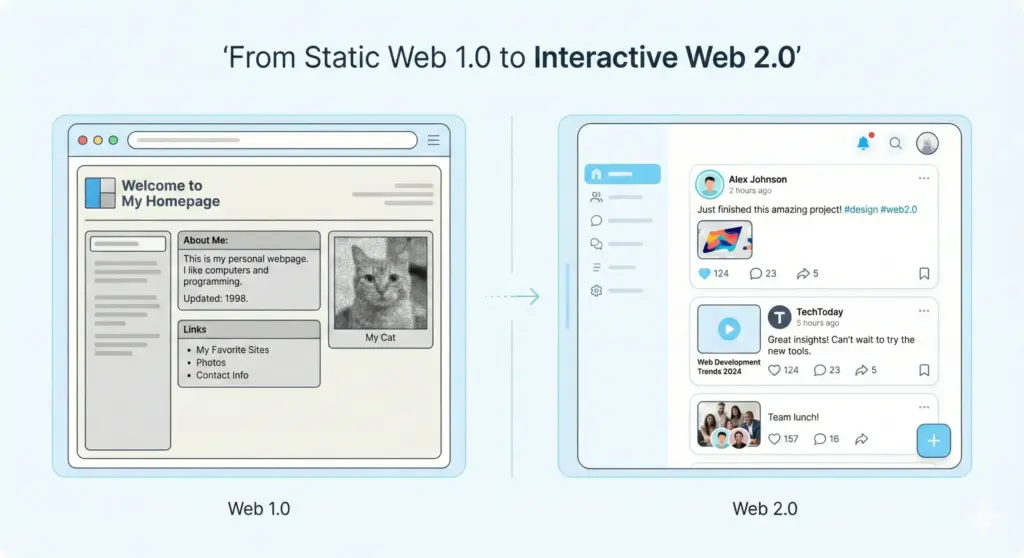
Web 1.0 was read-only and static. Web 2.0 is read-write and interactive.
| Aspect | Web 1.0 | Web 2.0 |
|---|---|---|
| User role | Passive readers | Active contributors |
| Content | Static HTML pages | Dynamic, database-driven |
| Creators | Webmasters and companies | Anyone with internet access |
| Interactivity | Minimal (forms, guestbooks) | High (comments, likes, social features) |
| Tech stack | Basic HTML, CGI scripts | AJAX, JavaScript, APIs, cloud |
| Communication | One-to-many broadcast | Many-to-many conversations |
| Examples | Early Yahoo, GeoCities | Facebook, YouTube, Wikipedia, Reddit |
Three Big Shifts:
Static to Dynamic
Web 1.0 sites looked the same to everyone. Web 2.0 generates personalized content based on who you are and what you’ve done.
Publisher-Controlled to User-Driven
Webmasters decided what appeared in Web 1.0. In Web 2.0, users determine what succeeds through contributions, votes, and shares.
Directories to Algorithms
Web 1.0 used manually curated directories. Web 2.0 uses search and recommendation engines that surface content based on behavior and connections.
Real-World Web 2.0 Examples
Web 2.0 covers social media, content-sharing platforms, collaboration tools, and community sites that billions use daily across the United States and globally. Here are real-world examples of web 2.0 platforms you likely interact with regularly.
Social Media Platforms:
Facebook launched in 2004 and now has billions of monthly active users. Its news feed algorithm, Groups feature, and Marketplace turn social connections into a comprehensive platform for communication, community building, and commerce.
Twitter/X pioneered microblogging with 280-character posts and real-time conversation threads. Hashtags organize discussions around events, topics, and movements, making it a go-to platform for news and public discourse.
Instagram focuses on photo and video sharing through posts, Stories, and Reels. Heavy user-generated content and influencer presence make it central to visual marketing and personal branding.
LinkedIn connects professionals for networking, job searching, and B2B content distribution. It’s where career updates, industry insights, and business relationships happen online.
Content Sharing & Communities:
YouTube became the world’s largest video platform entirely through user uploads. Creators build audiences in every niche imaginable, from education to entertainment to product reviews.
TikTok popularized short-form video with an algorithm that surfaces content based on engagement rather than follower counts. This democratizes discovery and lets anyone go viral.
Reddit organizes into thousands of topic-based communities (subreddits) where users post links, discussions, and questions. Upvotes and downvotes determine what rises to the top.
Quora operates as a question-and-answer platform where users provide answers and upvote the most helpful responses. It’s become a significant source of long-tail search traffic.
Collaboration & Publishing:
Wikipedia proves that collaborative editing works at massive scale. Millions of articles across hundreds of languages exist because volunteers can contribute and improve content freely.
WordPress powers a huge portion of websites through themes, plugins, and user-friendly publishing tools. It turned blogging from a technical exercise into something anyone could do.
Google Docs enables real-time collaborative editing directly in the browser. Multiple people can work on the same document simultaneously, seeing each other’s changes instantly.
These interactive websites demonstrate how Web 2.0 transformed the internet from a library into a workshop where everyone contributes.
Social Media, Online Communities, and Web 2.0
Web 2.0 changed social media and online communities by replacing one-way broadcast with many-to-many interaction.
Democratization of Publishing
Anyone can become a creator without traditional gatekeepers. YouTube channels, TikTok accounts, podcasts, and blogs let people build audiences without permission from studios or publishers.
Community Formation
Facebook Groups, subreddits, Discord servers, and forums connect people across geography who share interests. These communities provide support and knowledge that members often can’t find locally.
Real-Time Communication
Live chat, instant comments, livestreams, and DMs support back-and-forth exchanges in seconds. This immediacy changes how people organize and maintain relationships.
Social Movements
Hashtags and viral sharing amplify voices and coordinate action globally. Movements use platforms to organize, spread awareness, and apply pressure in ways impossible when media companies controlled distribution.
Benefits of Web 2.0 for Business
Marketing & Visibility
Social platforms let small and mid-size businesses reach targeted audiences at lower cost than TV or print. When content resonates, user sharing drives traffic spikes without paid promotion.
Customer Engagement & Service
Real-time replies through comments, DMs, and reviews handle questions and complaints in public and private channels. Two-way dialogue builds trust and shows the human side of your brand.
User-Generated Content as Social Proof
Reviews on Google, Yelp, TripAdvisor, and Amazon heavily influence purchase decisions. Photos and testimonials from actual customers carry more credibility than brand ads.
Community-Driven Loyalty
Brand communities on Facebook Groups, Reddit, or Discord deepen relationships beyond transactions. Customers who identify with a community stay longer and recommend you more often.
Use Web 2.0 properties as listening posts to learn what customers care about. Their questions and conversations reveal insights that surveys often miss.
Web 2.0, SEO, and Digital Marketing
User-Generated Content & Long-Tail Search
Reviews, comments, and community threads include specific phrases people use when searching. These long-tail keyword variations capture lower-competition searches that often convert better. A review mentioning “best waterproof hiking boots for wide feet” targets a precise query that product pages alone might miss.
Social Signals & Traffic
Social activity doesn’t directly influence Google rankings, but it drives branded searches, referral traffic, and natural backlinks. Google sees these signals as evidence that content resonates.
Web 2.0 Backlinks
Publishing unique content on platforms like Medium or industry blogs can earn authoritative backlinks. Quality matters more than volume. Spammy link schemes have been devalued by algorithm updates.
Checkout our vetted and high quality Web 2.0 site list if you want to make your own backlinks.
Content Distribution & SERP Features
Social sharing signals engagement and relevance, helping content appear in featured snippets, People Also Ask, and AI Overviews. Google’s AI features prioritize helpful content with clear answers and supporting context.
Web 2.0 vs Web 3.0
Web 3.0 aims for decentralization, user data ownership, and blockchain-based systems. Most daily internet activity still happens on Web 2.0 platforms.
| Aspect | Web 2.0 | Web 3.0 |
|---|---|---|
| Control | Centralized platforms (Google, Meta) | Decentralized networks on blockchain |
| Data ownership | Platforms store and monetize user data | Users control keys and data access |
| Main focus | Social interaction, UGC, SaaS | Transparency, trustless transactions |
| Tech stack | HTML5, JavaScript, AJAX, REST APIs | Blockchain, smart contracts, IPFS, AI/ML |
| Monetization | Ads, subscriptions, SaaS licensing | Tokens, cryptocurrencies, NFTs |
| UX maturity | Highly polished and simple | Early-stage, requires wallet management |
Key Points:
Web 3.0 promises more user control through blockchain technology. Smart contracts execute transactions automatically. Decentralized storage distributes files across networks.
In practice, Web 3.0 still relies on Web 2.0 infrastructure. Most decentralized apps use centralized cloud services, interfaces, and social channels. User experience requires managing wallet keys and navigating complex concepts.
The difference is significant conceptually, but the practical gap between promise and implementation remains wide.
Is Web 2.0 Still Relevant?
Yes. Web 2.0 remains dominant with mature infrastructure and proven business models. Web 3.0 will likely complement rather than replace it.
Why Web 2.0 Still Matters:
Most daily tasks run on Web 2.0 platforms: searching Google, checking email, shopping, watching videos, working in cloud apps. These activities show no signs of migrating to blockchain alternatives.
User experience is simpler. You don’t need to manage wallets, remember seed phrases, or understand blockchain to use Facebook, YouTube, or Google Docs.
Hybrid Future Expected:
Many Web 3.0 apps rely on Web 2.0 behind the scenes for hosting, content delivery, and user interfaces. Communities organize on Discord, Twitter, and Telegram.
Expect Web 2.0 to handle user experience and reach while Web 3.0 provides specific functionality around decentralized finance and digital ownership.
Limitations and Risks of Web 2.0
Privacy & Tracking
Centralized platforms collect detailed behavioral and personal data for targeted advertising. Users often lack visibility into how information gets used or shared.
Security & Downtime
Breaches at major companies can expose millions of records because data lives in central databases. Platform outages can cascade across dependent services.
Misinformation & Echo Chambers
Open publishing makes low-quality content and misinformation harder to filter. Algorithmic feeds can reinforce existing beliefs by showing more of what you already engage with.
Platform Control
Policy changes, algorithm updates, and account suspensions can materially affect creators and businesses. When platforms change rules, entire business models can become unviable overnight.
Wrapping Up
Web 2.0 is the backbone of today’s interactive internet. Posting on social media, collaborating on documents, watching videos, reading reviews – you’re engaging with Web 2.0 every day.
Understanding Web 2.0 matters if you’re planning products, creating content, or building marketing strategies. The features that define it aren’t going away. They’re fundamental to how the internet works now.
Review your current site or application. Could you add better community features? Make content easier to share? Structure information more clearly for search? Small improvements that embrace Web 2.0 principles often deliver measurable results in engagement and traffic.
Frequently Asked Questions
What is Web 2.0 and how does it work?
Web 2.0 is the interactive internet where users create and share content, not just read it. It uses AJAX and JavaScript to update pages dynamically, databases to store user content, and APIs to connect services.
What are the main features of Web 2.0 websites?
User-generated content, real-time interactivity (likes, comments, shares), social networking, collaboration tools, rich interfaces, tagging systems, browser-based software, and open participation.
How is Web 2.0 different from Web 1.0?
Web 1.0 was static pages you could only read. Web 2.0 is dynamic content you can create, edit, and share. Users shifted from passive consumers to active contributors.
What are real-world examples of Web 2.0 platforms?
Facebook, YouTube, Instagram, Twitter, Reddit, Wikipedia, Google Docs, WordPress, TikTok, and LinkedIn.
How does Web 2.0 impact digital marketing and SEO?
User-generated content creates long-tail keywords that drive organic traffic. Social sharing generates backlinks and branded searches. Quality Web 2.0 content can rank and appear in featured snippets.
What is the difference between Web 2.0 and Web 3.0?
Web 2.0 uses centralized platforms (Google, Meta) that control user data. Web 3.0 aims for decentralized, blockchain-based networks where users own their data. Web 3.0 is still early-stage while Web 2.0 dominates daily use.
When did Web 2.0 start?
The term was coined in 1999 by Darcy DiNucci and popularized at the 2004 Web 2.0 Conference. Major platforms like Facebook (2004) and YouTube (2005) launched during this period, marking the practical start of Web 2.0.
Is Web 2.0 still used today?
Yes, Web 2.0 platforms dominate the internet. Billions of people use Facebook, YouTube, Google services, and other Web 2.0 sites daily for work, entertainment, and communication.
What technologies power Web 2.0 applications?
AJAX, JavaScript, HTML5, CSS3, REST APIs, server-side languages (PHP, Python, Node.js), databases (MySQL, PostgreSQL), JSON/XML for data exchange, and cloud infrastructure.
Can businesses still benefit from Web 2.0?
Absolutely. Social media marketing, customer engagement through reviews and comments, community building, and user-generated content remain effective strategies for business growth and customer retention.
What is user-generated content in Web 2.0?
User-generated content (UGC) includes posts, comments, reviews, photos, videos, and articles created by platform users rather than companies. It’s the foundation of sites like YouTube, Reddit, and TripAdvisor.
How did Web 2.0 change the internet?
Web 2.0 shifted the internet from read-only pages to interactive platforms. It enabled social networking, collaborative editing, real-time communication, and turned users into content creators rather than just consumers.
What are Web 2.0 backlinks?
Web 2.0 backlinks are links from user-generated content platforms like Medium, WordPress.com, or Blogger. When done with quality content, they can support SEO, but spammy tactics have been devalued by Google.
Why is it called Web 2.0?
The “2.0” suggests a second version or upgrade from Web 1.0. It’s a conceptual label describing the evolution to interactive, user-driven platforms rather than a technical version number.